ladanum video 1

ladanum video2

ladanum video 3

Saturday, November 18, 2006

Balm of Gilead


http://web.odu.edu/webroot/instr/sci/plant.nsf/pages/cistus

Why There May Be No Balm in Gilead(1)
Balm of Gilead is an image familiar to Bible students even though it is mentioned in only
two verses. The weeping prophet, as Jeremiah is known, writes in Jeremiah 8:22, "Is there
no balm in Gilead? Is there no physician there? Why then is there no healing for the wound
of my people?" What is this product of Gilead?
First, what is Gilead? According to the biblical account in the book of Joshua(2), Gilead is
apparently the region from the middle of the Arnon Gorge (Wadi Mujib) to Mount Hermon
(Jebel Al Sheik) with the Jabbok River (Zarqa River) being the middle of the territory. This
included the domain of the Ammonites and the Amorites as well as the region known as
Bashan. In division of territory to the patriarchs, Gilead was apportioned to the half tribe of
Manasseh (the other half remained west of the Jordan River), Reuben, and Gad.
Although a small area in terms of square kilometers, Gilead is diverse stretching from the
margins of the Jordan valley and the peaks along the Rift Valley to the edge of the Badia
(steppe). In ancient times parts of Gilead were covered with forests. These forests were the
Balm of Gilead http://web.odu.edu/webroot/instr/sci/plant.nsf/pages/cistus
2 of 8 29/11/2004 10:16 µµ
southernmost extension of their kind, and the southern extreme of the range of the Aleppo
pine. Today, only vestiges of these forests remain. A prime example is Dibbeen National
Park.
At Dibbeen and scattered other remnants in the area, the forest is dominated by the Aleppo
pine. This tree is familiar to anyone who has visited Jordan because it is widely planted. It
probably only formed extensive forests, however, in areas with higher rainfall. Pines are the
dominant trees but oak (ballot), pistacia (buttim), and carob (kharrob) are also present.
A feature of the natural pine forest is a distinct stratification of the vegetation. The trees are
the upper layer. Much closer to the ground is a layer of shrubs, dominated by two species of
the genus Cistus. More on these later. Closer yet to the soil are numerous non-woody plants,
many of them in the legume family.
One of the characteristics of plants found in this vegetation type is the presence of essential
oils, literally oils that have an essence. Pine would fit this category as would numerous of
the understory shrubs. Some, like the legume Ononis, have sticky hairs. Others, like various
members of the mint family, lack the sticky hairs but contain oils that are evident when the
plant is crushed.
If the forest is degraded through heavy grazing, the oaks will predominate. This sort of
forest is evident in the hills north of Ajlon as at Istayfanah. Here, you will not see a distinct
stratification although the flora is rich and diverse. In the spring, the forest contains showy
plants such as orchids and anemones which are most common at the margins where more
light is available.
For me, the most desirable time to visit Dibbeen is in the late spring in the afternoon. Shrubs
are still green, some flowers of Cistus are present. After the hot day, resin is obvious on the
plants. Pine leaves, Cistus, and various native mints combine to give a sweet fragrance. The
long rays of the sun in the late afternoon cast a special light over the forest. The clear,
brilliant rays and contrasting shadows create a primeval ambience. It is quiet except for that
special, calming sound of a light breeze through the leaves of the pine. In the distance you
can sometime hear a shepherd playing his pipe. In a personal sense, this is a balm in Gilead
for me!
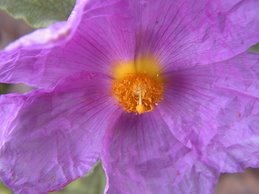
Two species of Cistus are common in the pine forest, C. creticus and C. salvifolius. They are
easily distinguished by their flower color. The large pink flowers of C. creticus and the
slightly smaller but equally beautiful white flowers of C. salvifolius appear in May. On a hot
day, the fragrant resin of the plants is obvious. Upon closer examination, you can see the
numerous hairs that cover the leaves and young stems of both species. The resin will stick to
your hands if you collect leaves.
Cistus' resin is fragrant, as noted, and has been used for millennia to produce an incense.
Even today, the resin is collected in parts of Greece. It can be harvested in a variety of ways.
One ancient method is to comb the hair of goats who graze in plant communities where
Cistus is abundant. Another is by dragging a rake with long, leather tines across the shrubs
at the hottest time of day and then removing the resin when it is dry(3). To my knowledge, it
does not have any widespread use among modern Arabs.
Balm of Gilead http://web.odu.edu/webroot/instr/sci/plant.nsf/pages/cistus
3 of 8 29/11/2004 10:16 µµ
I have not found any local familiarity with the plants. When some Bedouin near Anjara were
asked the value of the plant, they simply replied that it was good forage for sheep and goats
indicating why the shrub is absent in heavily grazed areas.
The resin is also used for medicine, as a balm that can reduce inflammation of the skin.
Recent research on the biochemistry of the plant has shown the efficacy of compounds in
the plant for dermatological disorders(4).
Other resins extracted from plants in this type of Mediterranean community include mastic.
This is derived from the sap of at least two species of the genus Pistacia. The highest
quality comes from P. lentiscus on the Greek island of Chios. Such trees may have occurred
in Gilead in ancient times. However, there is no documentation for this. Another candidate
is the resin of the Aleppo pine which has been used as a pitch and gum. Use of the resin for
balm is unknown.
Back to Gilead. Is it possible these species of Cistus were widespread and more common
throughout Gilead and used as a medicine? Could this be the balm of Gilead? Again, the
weeping prophet in Jeremiah 46: 11: "Go up to Gilead and get balm, O virgin daughter of
Egypt. But you multiply remedies in vain; there is no healing for you." This implies that
Gilead was a special source of the medicine. If so, why was Gilead chosen as a site for
harvesting the balm rather than similar areas west of the Jordan? We simply don't know. Nor
should we neglect the possibility that the prophet Jeremiah was speaking in a metaphorically
way.
What is certain is that the beautiful Cistus shrubs, perhaps the most likely candidate for the
balm of Gilead, are much less frequent now then in previous years. This is due to the
widespread destruction of the forest type that harbors them. To ensure that future
generations of Jordanians can appreciate these attractive members of the indigenous flora,
they need to be protected. This can only be done by preserving the forest in which they
grow. Otherwise, there will be no balm in Gilead.
ENDNOTES
1. Adapted in part from Musselman, L. J. 2000. Jordan in Bloom.
2. Joshua 12:2.
3. Baumann, H. 1996. The Greek Plant World in Myth, Art and Literature. Translated by W. T. and E.
R. Stearn. Portland: Timber Press.
4. Baumann, H. 1996. The Greek Plant World in Myth, Art and Literature. Translated by W.
T. and E. R. Stearn. Portland: Timber Press. Danne, A., F. Peterett and A. Nahrstedt. 1993.
Proanthocyanidins from Cistus incanus. Phytochemistry 34(4): 1129-1133.
Rock rose
In my last lecture, I spoke at length about rockrose, or Balm of Gilead. Because it may be
Balm of Gilead http://web.odu.edu/webroot/instr/sci/plant.nsf/pages/cistus
4 of 8 29/11/2004 10:16 µµ
confused with some of the other plants used for balm, especially myrrh, I want to refer to it
again and draw upon some recent research.
Two species of Cistus are common in Syria, C. creticus and C. salvifolius. They are easily
distinguished by their flower color. The large pink flowers of C. creticus and the slightly
smaller but equally beautiful white flowers of C. salvifolius appear in May. On a hot day,
the fragrant resin of the plants is obvious. Upon closer examination, you can see the
numerous hairs that cover the leaves and young stems of both species. The resin will stick to
your hands if you collect leaves.
Cistus' resin is fragrant, as noted, and has been used for millennia to produce an incense.
Even today, the resin is collected in parts of Greece. It can be harvested in a variety of ways.
One ancient method is to comb the hair of goats who graze in plant communities where
Cistus is abundant. Another is by dragging a rake with long, leather tines across the shrubs
at the hottest time of day and then removing the resin when it is dry(1). To my knowledge, it
does not have any widespread use among modern Arabs.
The resin is also used for medicine, as a balm that can reduce inflammation of the skin.
Recent research on the biochemistry of the plant has shown the efficacy of compounds in
the plant for dermatological disorders(2). Recent research in Turkey shows that, of the seven
plants used as folk remedies for ulcers, the one with the greatest efficacy was C.
salvifolius(3).
Endnotes
1. Baumann, H. 1996. The Greek Plant World in Myth, Art and Literature. Translated by W.
T. and E. R. Stearn. Portland: Timber Press.
2. Danne, A., F. Peterett and A. Nahrstedt. 1993. Proanthocyanidins from Cistus incanus.
Phytochemistry 34(4): 1129-1133.
3. Yesilada E., I. Gurbuz, and H. Shibatajavascript: do_literal('AU=(Gurbuz I)');. 1999.
Screening of Turkish anti-ulcerogenic folk remedies for anti-Helicobacter pylori activity.
Journal of Ethnopharmacology 66(3):289-93. (The other plants were Spartium junceum,
cones of Cedrus libani, herbs and flowers of Centaurea solstitialis ssp. solstitialis, fruits of
Momordica charantia, herbaceous parts of Sambucus ebulus, and flowering herbs of
Hypericum perforatum.)
Balm of Gilead http://web.odu.edu/webroot/instr/sci/plant.nsf/pages/cistus
5 of 8 29/11/2004 10:16 µµ
Balm of Gilead http://web.odu.edu/webroot/instr/sci/plant.nsf/pages/cistus
6 of 8 29/11/2004 10:16 µµ
Balm of Gilead http://web.odu.edu/webroot/instr/sci/plant.nsf/pages/cistus
7 of 8 29/11/2004 10:16 µµ
Balm of Gilead http://web.odu.edu/webroot/instr/sci/plant.nsf/pages/cistus
8 of 8 29/11/2004 10:16 µµ

Cistus creticus subsp incanus - Cistaceae - Rock Rose

http://seeds.thompson-morgan.com/uk/fr/product/kw9300/1

Arbuste à feuillage persistant
Floraison: Summer
Hauteur: 75cm
Guide de rusticité: 8 9
Germination: Expérience utile
Entretien: Entretien et soins nécessaires
Désignation: A charming evergreen shrub, quick to
flower from seed, often within 18 months. This older
variety was seen in gardens back in the 1700's. The
rich-pink blooms create a stunning carpet. Hardy in
the UK, Europe, Japan & Australia.
Of Mediterranean origin, the name Cistus is a
modified form of the Greek, kistos, while creticus is
a word which denotes that this particular species is
from Crete. Cistus belongs to the Rock Rose family,
a group which also includes Halimum,
Helianthemum and Halimocistus to name but a few.
Excellent ground cover as the plant naturally keeps
very low to the ground and the flowers are almost
stemless. Can also be used as miniature hedging or
at the front of cottage garden borders.
Semis: Sow February to July at 15-20C (59-68F) on
the surface of a good, free-draining compost, do not
cover seed. Place in a propagator or seal container
in a polythene bag until after germination which
usually takes 14-30 days. Do not exclude light at
any stage as this is beneficial to germination. It is
often beneficial to chip seed coat prior to sowing.
Culture: Pricking out (Transplanting): Cistus dislike
root disturbance so transplant as soon as large
enough to handle into 7.5cm (3in) pots. Grow on in
cool conditions. Planting out: When well grown,
gradually acclimatise to outdoor conditions before
planting out after all risk of frost, 45cm (18in) apart.
Prefers a poor but well drained soil in full sun. Can
tolerate winds, therefore a good maritime plant.
Entretien: Prune back any straggly growth on young
plants during March.
Catalogues Thompson et Morgande Graines et de plantes en lign

Bibliografia Cistus

Bibliografia Cistus
http://www.inea.it/istflo/wkgrmedi/bibliocistus.htm#albidus

1 of 7 29/11/2004 10:05 µµ
GERMOPLASMA
MEDITERRANEO
Bibliografia
Cistus
(It.: Cisto ; En.: Rockrose)
C. monspeliensis
C. albidus
C. creticus ( = C. incanus
subsp. creticus)
C. incanus
C. ladanifer
C. monspeliensis
C. salviaefolius
C. salviaefolius C. 'Silver Pink'
C. albidus
Corral R., Perez-Garcia F., Pita J.M., 1989. Seed morphology and
histology in four species of Cistus L. (Cistaceae). Phytomorphology,
39 (1): 75-80.
Iriondo J.M., Moreno C., Perez C., 1995. Micropropagation of six
rockrose (Cistus) species. HortScience, 30 (5):.
Leduc J.P., Dexheimer J., Chevalier G., 1985. Etude ultrastructurale
comparee des associations de Terfezia leptoderma avec
Helianthemum salicifolium, Cistus albidus et Cistus salviaefolius.
Proceedings of the 1st European Symposium on Mycorrhizae, Dijon, 1-5
July 1985, 291-295.
Llusia J., Penuelas J., 2000. Seasonal patterns of terpene content and
emission from seven Mediterranean woody species in field
conditions. American journal of botany, 87 (1): 133-140.
Oliveira G., Penuelas J., 2001. Allocation of absorbed light energy into
photochemistry and dissipation in a semi-deciduous and an
evergreen Mediterranean woody species during winter. Australian
journal of plant physiology, 28 (6): 471-480.
Robles C., Garzino S., 1998. Essential oil composition of Cistus albidus
leaves. Phytochemistry, 48 (8):.
Sanchez-Blanco M.J., Rodriguez P., Morales M.A., Ortuno M.F., Torrecillas
A., 2002. Comparative growth and water relations of Cistus albidus
and Cistus monspeliensis plants during water deficit conditions and
recovery. Plant science, 162 (1): 107-113.
Bibliografia Cistus http://www.inea.it/istflo/wkgrmedi/bibliocistus.htm#albidus
2 of 7 29/11/2004 10:05 µµ
Vuillemin J., Bulard C., 1981. Ecophysiologie de la germination de
Cistus albidus L. et Cistus monspeliensis L..Naturalia
monspeliensia. Serie botanique, 46, 11 p.
C. creticus , C. incanus
Anastasaki T., Demetzos C., Perdetzoglou D., Gazouli M., Loukis A.,
Harvala C., 1999. Analysis of labdane-type diterpenes from
Cistus creticus (subsp. creticus and subsp. eriocephalus), by
GC and GC-MS. Planta medica, 65 (8): 735-739.
Aronne G., De Micco V., 2001. Seasonal dimorphism in the
Mediterranean Cistus incanus L. subsp. incanus. Annals of
botany, 87 (6): 789-794.
Berliner R., Jacoby B., Zamski E., 1986. Absence of Cistus incanus
from basaltic soils in Israel: effect of mycorrhizae. Ecology : a
publication of the Ecological Society of America, 67 (5):.
Berliner R., Jacoby B., Zamski E., 1987. Mycorrhiza is essential for
phosphate supply to Cistus incanus L. on native soils in
northern Israel. Journal of plant nutrition, 10 (9/16):.
Bjorn L.O., Callaghan T.V., Johnsen I., Lee J.A., Manetas Y., Paul N.D.,
Sonesson M., Welburn A.R., Coop D., Heide-Jorgensen, H.S., 1997.
The effects of UV-B radiation of European heathland species.
Plant ecology, 128 (1/2): 252-264.
Chinou I., Demetzos C., Harvala C., Roussakis C., Verbist J.F., 1994.
Cytotoxic and antibacterial labdane-type diterpenes from the
aerial parts of Cistus incanus subsp. creticus. Planta medica,.
Danne A., Petereit F., Nahrstedt A., 1993. Proanthocyanidins from
Cistus incanus. Phytochemistry, 34 (4):.
Demetzos C., Harvala C., Philianos S.M., Skaltsounis A.L., 1990. A
new labdane-type diterpene and other compounds from the
leaves of Cistus incanus ssp. creticus. Journal of natural products,
53 (5):1365-1368.
Demetzos C., Katerinopoulos H., Kouvarakis A., Stratigakis N., Loukis
A., Ekonomakis C., Spiliotis V., Tsaknis J., 1997. Composition and
antimicrobial activity of the essential oil of Cistus creticus
subsp. eriocephalus. Planta medica, 63 (2): 477-479.
Demetzos C., Loukis A., Spiliotis V., Zoakis N., Stratigakis N., 1995.
Composition and antimicrobial activity of the essential oil of
Cistus creticus L. Journal of essential oil research, 7 (4): 407-410.
Demetzos C., Mitaku S., Couladis M., Havala C., Kokkinopoulos D.,
1994. Natural metabolites of ent-13-epi-manoyl oxide and other
cytotoxic diterpenes from the resin 'Ladano' of Cistus creticus.
Planta medica, 60 (6): 590-591.
Demetzos C., Mitaku S., Loukis A., Harvala C., Gally A., 1994. A new
drimane sesquiterpene, isomers of manoyl oxide and other
volatile constituents from the resin "Ladano" of Cistus incanus
subsp. creticus (L.) Heywood. Journal of essential oil research, 6
(1): 37-41.
Bibliografia Cistus http://www.inea.it/istflo/wkgrmedi/bibliocistus.htm#albidus
3 of 7 29/11/2004 10:05 µµ
Demetzos C., Mitaku S., Skaltsounis A.L., Harvala M.C.C., Libot F.,
1993. Diterpene esters of malonic acid from the resin 'Ladano' of
Cistus creticus. Phytochemistry35 (4): 979-981.
Demetzos C., Stahl B., Anastassaki T., Gazouli M., Tzouvelelis L.S.,
Rallis M., 1999. Chemical analysis and antimicrobial activity of
the resin Ladano, of its essential oils and of the isolated
compounds. Planta medica 65 (1): 76-78.
Fusconi A. , 1983. The development of the fungal sheath on Cistus
incanus short roots. Canadian journal of botany, 61 (10):.
Grammatikopoulos G. , 1999. Mechanisms for drought tolerance in
two Mediterranean seasonal dimorphic shrubs. Australian journal
of plant physiology, 26 (6): 587-593.
Gratani L., Bombelli A., 2000. Correlation between leaf age and other
leaf traits in three Mediterranean maquis shrub species:
Quercus ilex, Phillyrea latifolia and Cistus incanus.
Environmental and experimental botany, 43 (2): 141-153.
Hanley M.E., Fenner M., 1997. Seedling growth of four fire-following
Mediterranean plant species deprived of single mineral
nutrients. Functional ecology, 11 (3): 398-405.
Khazaal K.A., Parissi Z., Tsiouvaras C., Nastis A., Orskov E.R., 1996.
Assessment of phenolics-related antinutritive levels using the in
vitro gas production technique: a comparison between different
types of polyvinylpolypyrrolidone or polyethylene glycol. Journal
of the science of food and agriculture, 71 (4): 405-414.
Klocke J.A., Van Wagenen B., Balandrin M.F., 1986. The ellagitannin
geraniin and its hydrolysis products isolated as insect growth
inhibitors from semi-arid land plants. Phytochemistry, 25 (1):
85-91.
Kreimeyer J., Petereit F., Nahrstedt A., 1998. Separations of
flavan-3-ols and dimeric proanthocyanidins by capillary
electrophoresis. Planta medica, 64 (1): 63-67.
Manetas Y., Petropoulou Y., 2000. Nectar amount, pollinator visit
duration and pollination success in the Mediterranean shrub
Cistus creticus. Annals of botany, 86 (4): 815-820.
Papafotiou M., Triandaphyllou N., Chronopoulos J., 2000 Studies on
propagation of species of the xerophytic vegetation of Greece with
potential floricultural use. Acta Horticulture (ISHS) 541: 269-272.
Pela Z., Gerasopoulos D., Maloupa E., 2000. The effects of heat
pre-treatments and incubation temperature on germination of Cistus
creticus creticus seeds. Acta Horticulture (ISHS) 541: 365-372.
Pela Z., Pentcheva M., Gerasopoulos D., Maloupa E., 2000. In vitro
induction of adventitious roots and proliferation of Cistus creticus
creticus plants. Acta Horticulture (ISHS) 541: 317-322.
Peris J.B., Mateo G., Figuerola R., 1984. Sobre la presencia de
Cistus incanus L. en la Peninsula Iberica. Boletim da Sociedade
Broteriana, 57: 69-75.
Petereit F., Kolodziej H., Nahrstedt A., 1991. Flavan-3-ols and
proanthocyanidins from Cistus incanus. Phytochemistry 30 (3):
981-985.
Bibliografia Cistus http://www.inea.it/istflo/wkgrmedi/bibliocistus.htm#albidus
4 of 7 29/11/2004 10:05 µµ
Psaras G.K., Konsolaki M.J., 1986. The annual rhythm of cambial
activity in four subshrubs common in phryganic formations of
Greece. Israel journal of botany, 35 (1): 35-39.
Stephanous M., Manetas Y., 1997. The effects of seasons, exposure,
enhanced UV-B radiation, and water stress on leaf epicuticular
and internal UV-B absorbing capacity of Cistus creticus: a
Mediterranean field study. Journal of experimental botany, 48
(316):.
Stephanous M., Manetas Y., 1998. Enhanced UV-B radiation
increases the reproductive effort in the Mediterranean shrub
Cistus creticus under field conditions. Plant ecology, 134 (1):
91-96.
Stephanous M., Petropoulou Y., Georgiou O., Manetas Y., 2000.
Enhanced UV-B radiation, flower attributes and pollinator
behaviour in Cistus creticus: a Mediterranean field study. Plant
ecology, 47 (2): 165-171.
Sternberg M., Shoshany M., 2001. Aboveground biomass allocation
and water content relationships in Mediterranean trees and
shrubs in two climatological regions in Israel. Plant ecology, 157
(2): 173-181.
Thanos C.A., Georghiou K., 1988. Ecophysiology of fire-stimulated
seed germination in Cistus incanus ssp. creticus (L.) Heywood
and C. salvifolius. Plant, cell and environment, 11 (9):841-849.
Troumbis A.Y. , 1996. Seed persistence versus soil seed bank
persistence: the case of the post-fire seeder Cistus incanus L.
Écoscience 3 (4): 461-468.
Vardavakis E., 1988. Seasonal fluctuation of non-parasitic
mycoflora associated with living leaves of Cistus incanus,
Arbutus unedo and Quercus coccifera. Mycologia, 80 (2):
200-210.
C. ladanifer
Acosta F.J., Delgado J.A., Lopez F., Serrano J.M., 1997. Functional
features and ontogenic changes in reproductive allocation and
partitioning strategies of plant modules. Plant ecology, 132 (1):
71-76.
Alados C.L., Navarro T., Cabezudo B., 1999. Tolerance assessment
of Cistus ladanifer to serpentine soils by developmental stability
analysis. Plant ecology, 143 (1): 51-66.
Chaves N., Escudero J.C., Gutierrez-Merino C., 1993. Seasonal
variation of exudate of Cistus ladanifer. Journal of chemical
ecology, 19 (11):.
Chaves N., Escudero J.C., Gutierrez-Merino C., 1997. Quantitative
variation of flavonoids among individuals of a Cistus ladanifer
population. Biochemical systematics and ecology, 25 (5): 429-435.
Chaves N., Escudero J.C., Gutierrez-Merino C., 1997. Role of
ecological variables in the seasonal variation of flavonoid
content of Cistus ladanifer exudate. Journal of agricultural and
food chemistry, 45 (10): 579-603.
Bibliografia Cistus http://www.inea.it/istflo/wkgrmedi/bibliocistus.htm#albidus
5 of 7 29/11/2004 10:05 µµ
Chaves N., Escudero J.C., 1997. Allelopathic effect of Cistus
ladanifer on seed germination. Functional ecology, 11 (4): 432-440.
Chaves N. Rios J.J., Gutierrez C., Escudero J.C., Olias J.M., 1998.
Analysis of secreted flavonoids of Cistus ladanifer L. by
high-performance liquid chromatography-particle beam mass
spectrometry. Journal of chromatography, 799 (1/2): 111-115.
Corral R., Perez-Garcia F. Pita, J.M., 1989. Seed morphology and
histology in four species of Cistus L. (Cistaceae).
Phytomorphology., 39 (1): 75-80.
Delgado J.A., Serrano J.M., Lopez F., Acosta F.J., 2001.Heat shock,
mass-dependent germination, and seed yield as related
components of fitness in Cistus ladanifer. Environmental and
experimental botany, 46 (1): 11-20.
Dominguez M.T., 1994. Influence of polyphenols in the litter
decomposition of autochthonous (Quercus ilex L, Quercus
suber L, Pinus pinea L, Cistus ladanifer L, and Halimium
Halimifolium W.K.) and introduced species (Eucalyptus globulus
L. and Eucalyptus camaldulensis D.) in the southwest of Spain.
Acta Horticulturae 381, 425-428.
Ferrandis P., Herranz J.M., Martinez-Sanchez J.J., 1999. Effect of fire
on hard-coated Cistaceae seed banks and its influence on
techniques for quantifying seed banks. Plant ecology, 144 (1):
103-114.
Guy I., Vernin G., 1996. Minor compounds from Cistus ladaniferus
L. essential oil from Esterel. 2. Acids and phenols. Journal of
essential oil research, 8 (4): 455-462.
Iriondo J.M., Moreno C., Perez C., 1995. Micropropagation of six
rockrose (Cistus) species.HortScience, 30 (5):.
Lansac A.R., Martin A., Roldan A., 1995. Mycorrhizal colonization
and drought interactions of Mediterranean shrubs under
greenhouse conditions. Arid soil research and rehabilitation, 9 (2):
167-175.
Nunez-Olivera E., Martinez-Abaigar J., Escudero J.C., 1996.
Adaptability of leaves of Cistus ladanifer to widely varying
environmental conditions. Functional ecology, 10 (5): 636-646.
Paton D., Azocar P., Tovar J., 1998. Growth and productivity in
forage biomass in relation to the age assessed by
dendrochronology in the evergreen shrub Cistus ladanifer (L.)
using different regression models. Journal of arid environments,
38 (2): 221-235.
Pereira I.P., Dias A.S., Dias L.S., 1993. Effects of heat treatments on
the germination of Cistus landanifer L. Acta Horticulturae 344:
229-237.
Perez-Garcia F., 1997. Germination of Cistus ladanifer seeds in
relation to parent material. Plant ecology, 133 (1): 57-62.
Proksch P., Gulz P.G., Budzikiewicz H., 1980. Further oxygenated
compounds in the essential oil of Cistus ladanifer L. (Cistaceae).
Zeitschrift fur Naturforschung. Section C: Biosciences, 35 (7/8):
529-532
Bibliografia Cistus http://www.inea.it/istflo/wkgrmedi/bibliocistus.htm#albidus
6 of 7 29/11/2004 10:05 µµ
Proksch P., Gulz P.G., Budzikiewicz H., 1980. Phenylpropanoic acid
esters in the essential oil of Cistus ladanifer L. (Cistaceae).
Zeitschrift fur Naturforschung. Section C: Biosciences, 35 (3/4):
201-203.
Talavera S., Gibbs P.E., Herrera J., 1993. Reproductive biology of
Cistus ladanifer (Cistaceae). Plant systematics and evolution, 186
(3/4): 123-134.
Tomas-Lorente F., Garcia-Grau M.M., Nieto J.L., Tomas-Barberan F.A.,
1992. Flavonoids from Cistus ladanifer bee pollen.
Phytochemistry, 31 (6):.
C. monspeliensis
Angelopoulou D., Demetzos C., Dimas C., Perdetzoglou D., Loukis A. ,
2001. Essential oils and hexane extracts from leaves and fruits
of Cistus monspeliensis. Cytotoxic activity of ent-13-epi-manoyl
oxide and its isomers. Planta medica,67 (2): 168-171.
Angelopoulou D., Demetzos C., Perdetzoglou D., 2002. Diurnal and
seasonal variation of the essential oil labdanes and clerodanes
from Cistus monspeliensis L. leaves. Biochemical systematics and
ecology, 30 (3): 189-203.
Ascenao L., Pais M.S.S., 1981. Ultrastructural aspects of secretory
trichromes in Cistus monspeliensis. Tasks for vegetation science,
4, 27-38.
Cavero I., Livi O., 1970. Estrazione, frazionamento ed esame dei
costituenti del Cistus monspeliensis L. Ann. Chim., 60 (7):
469-482.
Demetzos C., Dimas K., Hatziantoniou S., Anastasaki T., Angelopoulou
D. , 2001. Cytotoxic and anti-inflammatory activity of labdane
and cis-clerodane type diterpenes. Planta medica, 67 (7): 614-618.
Glyphis J.P., Puttick G.M., 1989. Phenolics, nutrition and insect
herbivory in some garrigue and maquis plant species. Oecologia,
78 (2): 259-263.
Ibrahima A., Joffre R., Gillon D., 1995. Changes in litter during the
initial leaching phase: an experiment on the leaf litter of
Mediterranean species. Soil biology & biochemistry, 27 (7):
931-939.
Roble C., Garzino S., 2000. Infraspecific variability in the essential
oil composition of Cistus monspeliensis leaves. Phytochemistry,
53 (1): 71-75.
Sanchez-Blanco M.J., Rodriguez P., Morales M.A., Ortuno M.F.,
Torrecillas A., 2002. Comparative growth and water relations of
Cistus albidus and Cistus monspeliensis plants during water
deficit conditions and recovery. Plant science (Shannon, Ireland),
162 (1):107-113.
Vuillemin J., Bulard C., 1981. Ecophysiologie de la germination de
Cistus albidus L. et Cistus monspeliensis L. .Naturalia
monspeliensia. Serie botanique, 46, 11 p.
C. salviaefolius
Bibliografia Cistus http://www.inea.it/istflo/wkgrmedi/bibliocistus.htm#albidus
7 of 7 29/11/2004 10:05 µµ
Leduc J.P., Dexheimer J., Chevalier G., 1985. Etude ultrastructurale
comparee des associations de Terfezia leptoderma avec
Helianthemum salicifolium, Cistus albidus et Cistus
salviaefolius. Proceedings of the 1st European Symposium on
Mycorrhizae, Dijon, 1-5 July 1985, 291-295.
Ulteriore bibliografia
Inizio pagina
Home page Gruppo di Lavoro "Germoplasma Mediterraneo"
Home page